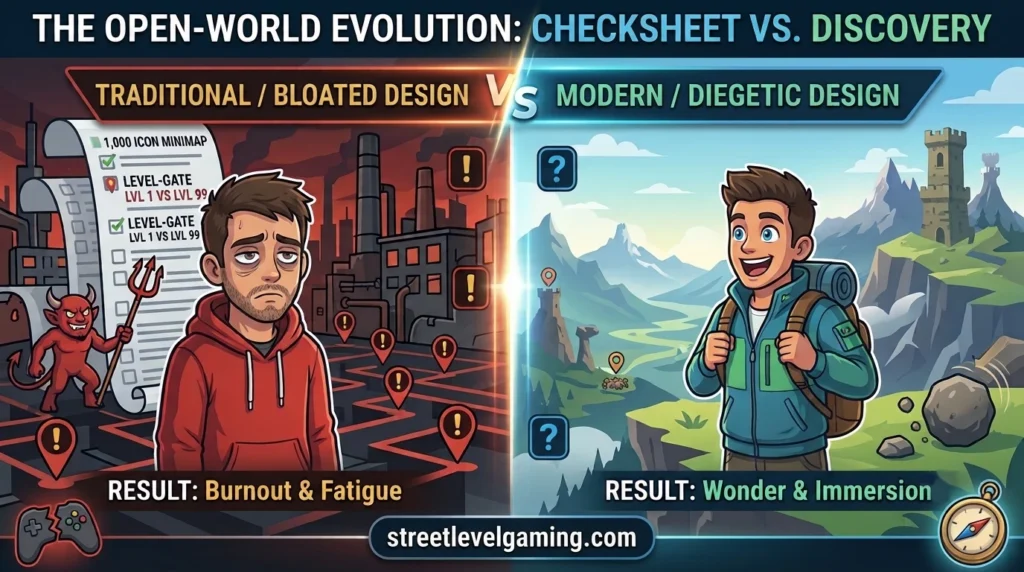
Featured breakdown: Burnout & Fatigue vs. Wonder & Immersion in open-world games.
The Dreaded Map Screen ~
You log in after a long day of work, boot up the latest AAA open-world blockbuster, open your map, and immediately freeze.
A wall of glowing icons aggressively stares back at you: 147 bandit camps, 82 mystery markers, 43 towers to climb, 20 collectible feather icons, and a dozen side errands demanding your attention. Instead of feeling a rush of wonder and adventure, your heart sinks. You haven't started playing a game—you've just clocked in for a second shift as a virtual administrative assistant.
Open-world games used to represent the ultimate gaming promise: "If you can see that mountain, you can walk to it." Today, that promise has mutated into: "If you see that icon, you must drive to it, hold 'E' for three seconds, clean out a chest full of grey-tier trash loot, and repeat 300 times."
How did one of gaming’s most beloved genres turn into a glorified chore simulator, and why are millions of gamers suffering from massive open-world burnout? More importantly, how are visionary developers breaking this cycle to revive the true thrill of adventure?
Unpacking Open-World Fatigue ~
Problem 1: The "Ubisoft Tower" Syndrome & Icon Pollution
Modern open-world design relies heavily on revealing the map through artificial vantage points or radio towers. Once unlocked, your minimap lights up like a Las Vegas casino. This strips away all mystery. Instead of naturally discovering a hidden cave, ancient ruin, or terrifying monster while wandering off the beaten path, you are simply following GPS waypoints like an automated delivery driver.
Problem 2: The Quantity vs. Quality Mirage (Map Bloat)
Developers love boasting about map size during marketing campaigns: "Our map is 4 times bigger than our previous game!" But bigger rarely means better. Massive open worlds are frequently padded with recycled assets, procedural filler, and empty traversal distances designed to artificially inflate playtimes to 80+ hours without adding actual narrative substance or memorable encounters.
Problem 3: Meaningless Loot & Level-Gated Progression
To stretch out progression, games force artificial RPG mechanics where they don't belong. You shoot an unarmored enemy directly in the head, but because they carry a red skull and are "Level 45" while you are "Level 20," your bullet deals 12 damage. You're constantly sorting through inventory menus to compare a sword with "+1.5% fire resistance" instead of discovering unique, game-altering gear.
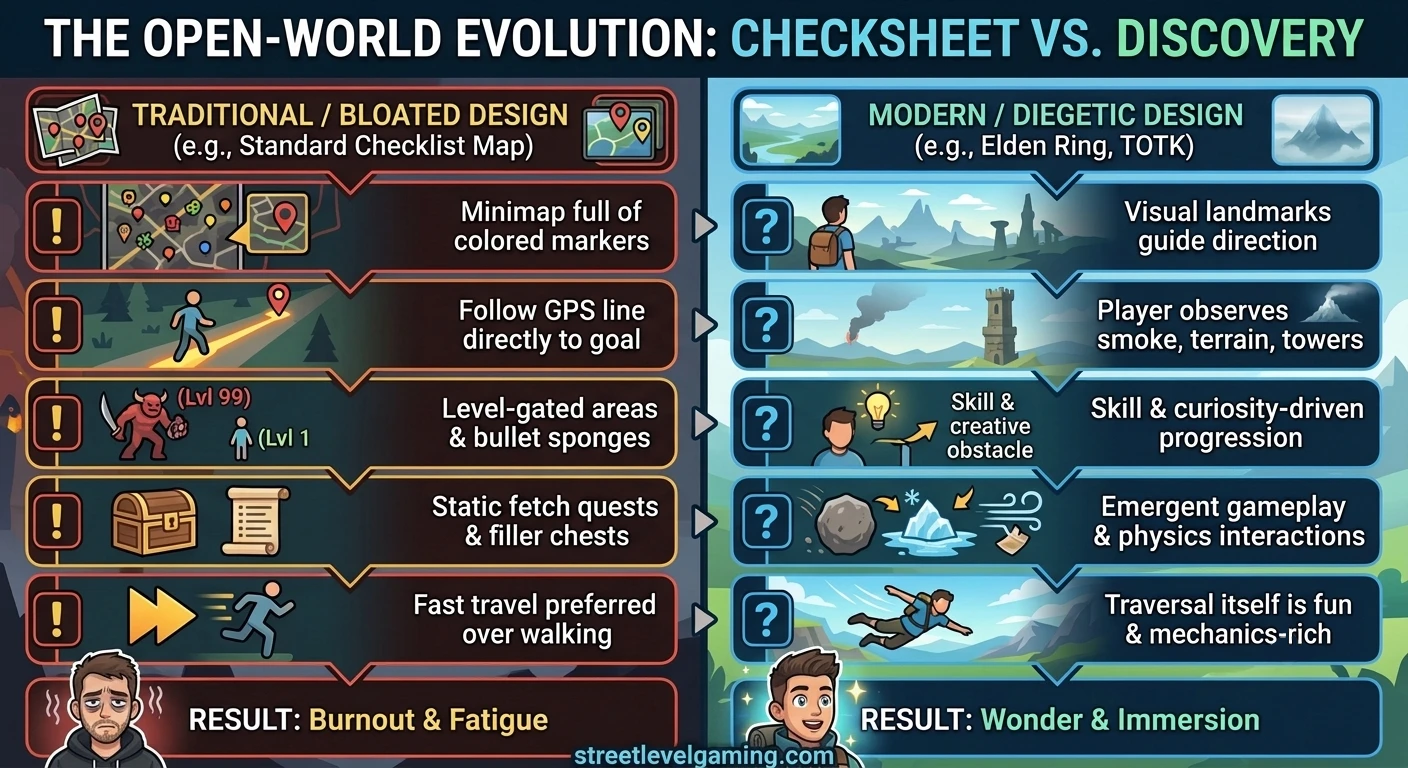
CHECKSHEET VS. DISCOVERY
To visualize why some open-world titles drag while others inspire awe, check out our breakdown comparing traditional checklist maps against modern diegetic exploration:
The Game Designer's Secret Paradox (And How Gamers Can Fix It Today)
Here is the mind-bending plot twist that most gamers never realize.
Psychology calls this "Hyper-Optimization Bias." When game studios give us a full minimap with 1,000 markers, our human brain treats it like an uncompleted to-do list instead of a playground. We stop playing for fun and start playing for dopamine hits triggered by clearing icons.
The Game-Changing 3-Step Solution for Gamers:
If you want to cure open-world fatigue right now without waiting for developers, try these three rules on your next playthrough:
1. The "No HUD" Rule: Turn off the minimap, compass, and floating quest markers in your settings. Forcing yourself to look at landmark structures (towers, smoke stacks, mountains) instead of a tiny circle in the corner immediately restores immersion in games like Red Dead Redemption 2, Cyberpunk 2077, and Ghost of Tsushima.
2. The "Rule of Two" Traversal Rule: Ban fast-travel entirely unless you have to cross the map twice in a single sitting. Forced movement forces you into spontaneous emergent encounters you would otherwise skip.
3. Ignore the 100% Completion Trap: Treat side quests like real life—if a stranger asks you to find 10 lost chickens and you're on your way to save the kingdom, say no. Stop treating games like spreadsheets!
How Developers Are Saving Exploration ?
For studios building the next generation of games, the cure for open-world fatigue isn't abandoning the genre altogether; it’s radically changing how games are designed.
1. Organic Curiosity over Minimap Icons
Masterpieces like The Legend of Zelda: Tears of the Kingdom and Elden Ring remove explicit UI hand-holding. They rely on diegetic design—smoke rising on the horizon, unusual rock formations, or distant architectural silhouettes—to pull players toward secrets naturally.
2. Traversal as a Core Gameplay Loop
If moving from Point A to Point B isn't fun, fast-travel becomes mandatory, and world design has failed. Games like Marvel's Spider-Man 2 (fluid web-swinging) and Grand Theft Auto V (satisfying driving physics) make the act of moving through the landscape an enjoyable mechanic in its own right.
3. Emergent Systems and Physics Interaction
Instead of rigid, scripted side quests, superior open worlds provide deep physics and environmental interactions. When you can combine elemental magic, construct makeshift vehicles, or trigger rival faction fights spontaneously, the world feels alive and reactive rather than static and predictable.
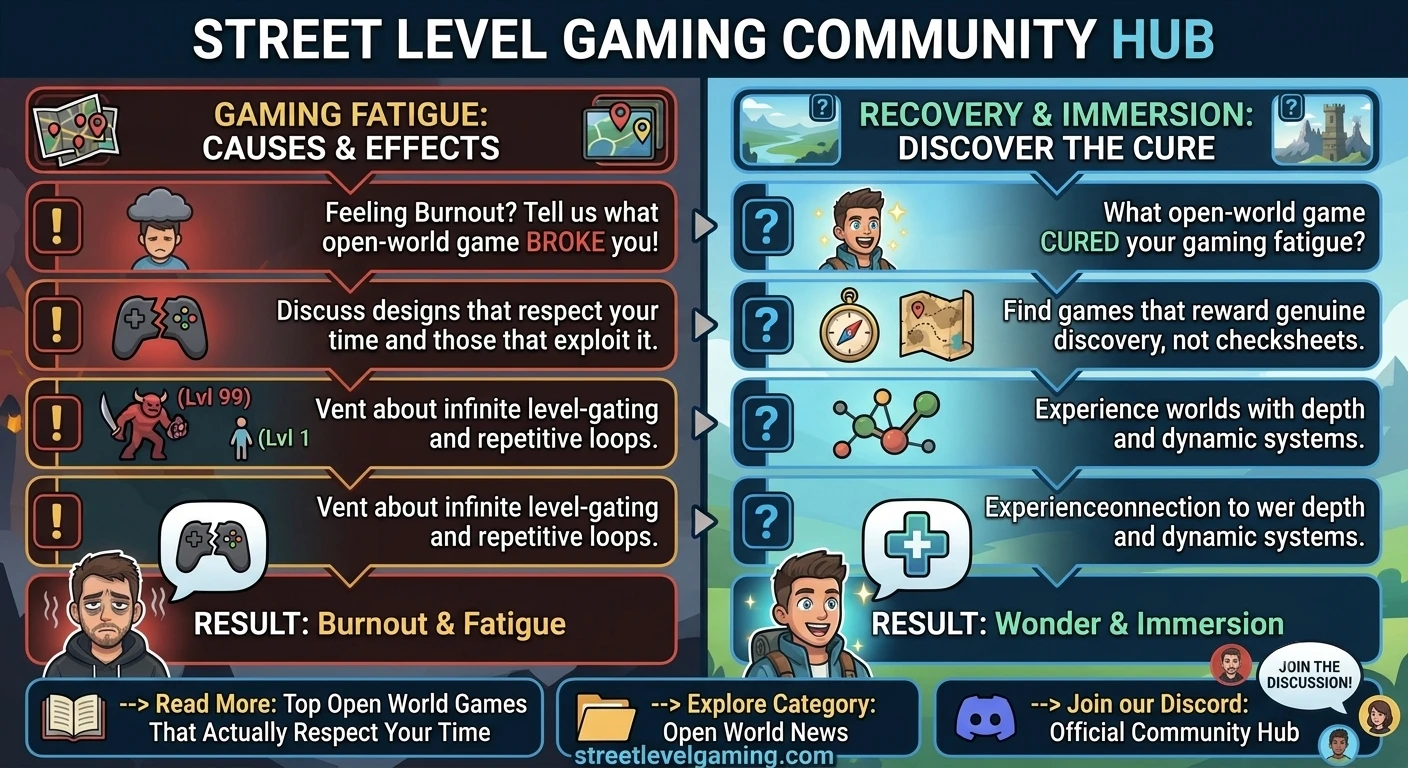
JOIN THE DISCUSSION
What open-world game cured your gaming fatigue, and which one completely broke your patience? Join the conversation with thousands of hardcore gamers in our official hub!
📖 Read More: Top Open World Games That Actually Respect Your Time
📂 Explore Category: Street Level Gaming - Open World News
💬 Join our Discord: Street Level Gaming Official Community Hub